

What Sounds Christian, May not be Christian - Guarding the Hearts and Faith of Our Children
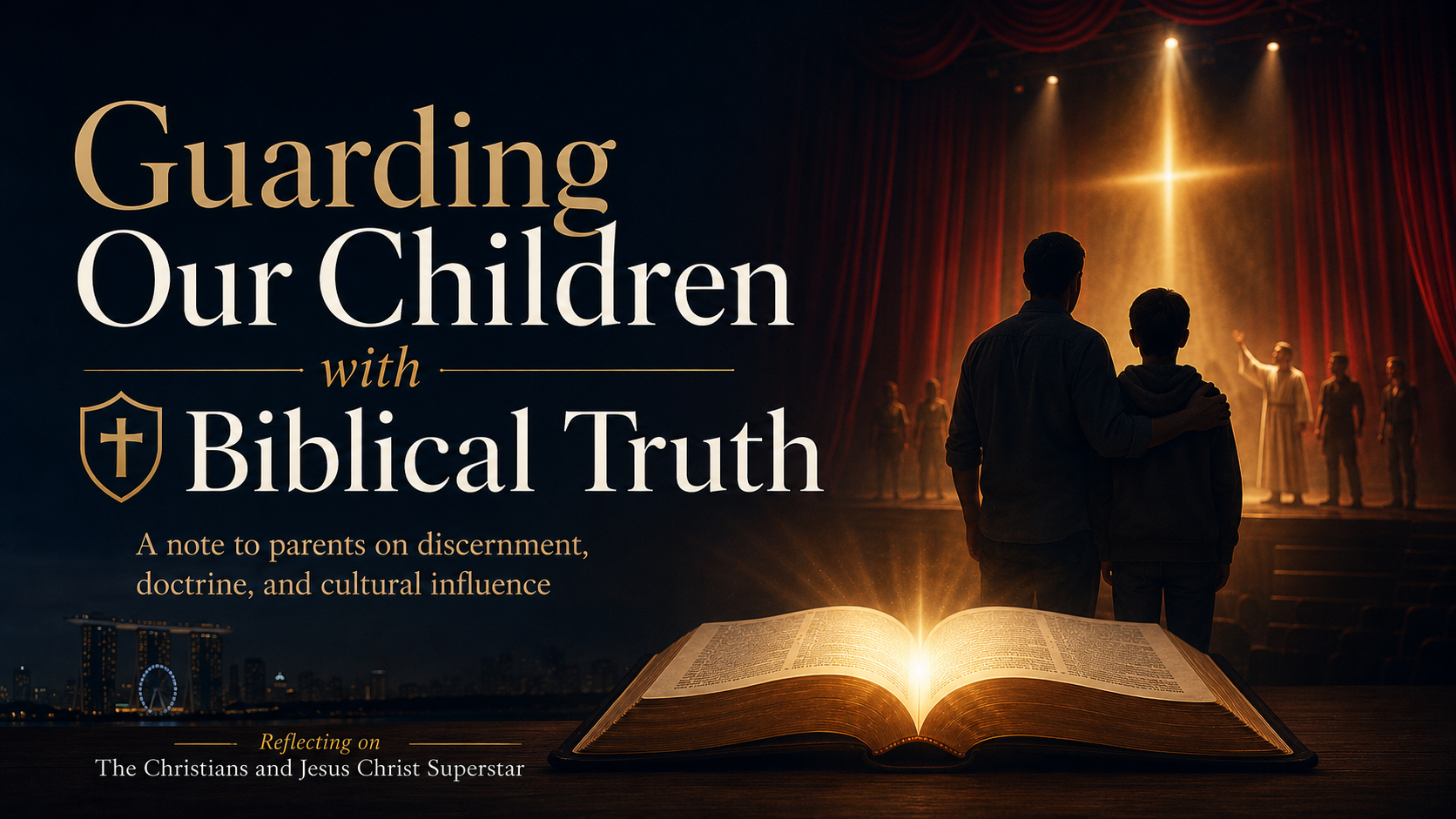
Beware - What sounds Christian, may not be Christian
Recent events remind us that we must be watchful over the spiritual formation of our children, especially our youth and young adults.
The concern is not simply that there are plays, musicals, or artistic productions that use Christian language or biblical themes. The deeper concern is this: some productions may sound Christian, look Christian, and use familiar church language, but the message presented may be doctrinally different from the Gospel we believe and teach.
One recent example is the play The Christians, staged in Singapore by WILD RICE. The play centres on Pastor Paul, a megachurch pastor who has spent over twenty years building a thriving congregation. According to WILD RICE’s own description, Pastor Paul delivers a sermon presenting an “unorthodox version of Hell and salvation,” which sends shockwaves through the church. A review in The Straits Times described the sermon as declaring, “We are no longer a congregation that believes in hell.”
This is the key theological issue.
Pastor Paul no longer believes that non-Christians are condemned to hell. Instead, he suggests that God’s grace and salvation may extend beyond the traditional evangelical understanding. This is not a small difference in interpretation. It changes the doctrine of sin, judgment, salvation, and the necessity of the cross.
The Bible teaches that hell is real, sin has consequences, and salvation is found only through Jesus Christ. Romans 6:23 tells us plainly:
“For the wages of sin is death, but the free gift of God is eternal life in Christ Jesus our Lord.”
When hell is taken out of the equation, the seriousness of sin is weakened. When judgment is removed, the urgency of repentance is diminished. When salvation is presented as extending beyond Christ, the necessity of the cross is undermined.
Christ did not die merely to give us a better life, a broader idea of grace, or a more inclusive religious message. He died for our sins so that we may be forgiven, reconciled to God, and saved from eternal judgment.
This is why parents must help their children understand the difference between something that sounds Christian and something that is doctrinally true. A production may include sermons, pastors, church settings, worship, prayers, and familiar Christian language, but still carry a message that challenges the Gospel.
The concern is not that difficult questions are being raised. The concern is that a different doctrine may be introduced through a familiar Christian setting. Young people who are not grounded in Scripture may not recognise the difference. They may come away thinking that all views are equally valid, when in fact the biblical Gospel is being challenged.
We should also be discerning about upcoming productions such as Jesus Christ Superstar, which will be staged in Singapore from 19 August to 6 September 2026 at Sands Theatre, Marina Bay Sands. The official Marina Bay Sands description states clearly that Jesus Christ Superstar is a theatrical production “inspired by historical events” and is “presented for entertainment purposes only.” The production is set during the final weeks in the life of Jesus Christ and is told through the eyes of Judas.
This means parents should not assume that a production with the name “Jesus Christ” in its title is a Christian teaching resource or a faithful presentation of biblical doctrine. It may use biblical characters, biblical events, and Christian-sounding language, but that does not mean it presents the Jesus of Scripture accurately.
This is how the battle for the hearts and minds of our young people may increasingly be fought, not always through open opposition to Christianity, but through messages that sound spiritual, appear familiar, and use Christian themes while introducing ideas that can weaken biblical conviction.
Family Altar - Our Layer of Protection
Yet Scripture also reminds us that God has placed different layers of restraint and protection in society against the spread of lawlessness and deception.
In 2 Thessalonians 2:3–12, Paul speaks about the “mystery of lawlessness” already at work in the world. He also speaks of a “restrainer” holding back the full expression of evil until the appointed time: “For the mystery of lawlessness is already at work. Only he who now restrains it will do so until he is out of the way.” (2 Thessalonians 2:7) When a society becomes increasingly corrupted and sin is normalised, what is evil may eventually appear right to the majority. Scripture warns us that restraint itself can be removed.
God has also established governments to preserve law and order. This is why Scripture instructs believers to pray for those in authority. Governments serve as a second layer of protection in maintaining social order and restraining wickedness. Yet governments are made up of sinful men and women. Political systems can drift with changing cultural sentiments, especially when truth is determined by popular opinion rather than by God’s Word.
The third layer is the church. The letters to the seven churches in Revelation 2 and 3 remind us that not every church remains spiritually strong. Some churches compromise with the world, tolerate false teaching, or gradually lose their first love for Christ.
This is why the final and most personal line of spiritual defense is the family. If fathers and mothers do not intentionally nurture godliness at home, the next generation will drift spiritually. We cannot depend entirely on society, the government, schools, or even church programs to disciple our children. The pursuit of holiness must begin at the family prayer altar. The family prayer altar is not merely a ritual of gathering for prayer. It is the place where parents teach their children who Jesus truly is. Jesus said, “I am the way, and the truth, and the life.” (John 14:6)
As fathers lead spiritually in the home, they must teach their children:
The Way - grounding them in moral character, obedience, and godly living.
The Truth - grounding the family in sound doctrine and biblical conviction.
The Life - grounding them in the meaning of salvation, the call to follow Christ, and the purpose of Christian living.
The spiritual leadership of fathers is not about control or harsh authority. It is about responsibility before God. Fathers are called to shepherd their homes, pray for their families, teach the Scriptures faithfully, and model a life that honours Christ. If fathers remain passive, the culture will disciple their children instead.
We cannot rely on the government, society, schools, or the arts community to be the gatekeepers of our children’s spiritual well-being. That responsibility begins at home. The call for fathers and mothers to rise up is urgent.
We must equip our children with the Word of God. We must teach them sound doctrine. We must help them understand sin, judgment, repentance, grace, the cross, and salvation through Christ alone. We must teach them not only to attend church, but to know what they believe, why they believe it, and how to stand firm when their faith is challenged.
Let us rebuild the prayer altar in our families. Let us teach our children to exercise their faith and be doers of God’s Word. Let us disciple them with courage, clarity, and conviction.
If Christian fathers and mothers do nothing, this generation may grow lukewarm, and the next generation may forget God. May we raise a generation that is rooted in Christ, grounded in Scripture, discerning in spirit, and courageous in truth.
Fook Loy
Fook Loy is a practitioner of process improvement who believes the most important "process" we can re-engineer is the way we disciple the next generation.